

1954—Current
HISTORY
With Augustine Justos help they managed to find sponsors and in1941, the first Biró ball pen was
produced it was called the Biróme. But unfortunately it didn't work very well. Biró began to feel the pressure. His largest financier, Henry Martin, had strong links to the British Air Force and Martin saw the Air Force as a potential customer, because the fountain pens had the flaw that they were no good at high altitudes and couldn't handle the changes in ait presseure. He was constantly on Biró, demanding results.
In 1943 the new Biró pen was ready. It worked so well that Henry Martin asked to buy the patent. Well, Lászlo Biró should have learnt from his past mistake with the gearbox, but he decided to sell. Soon, Martin sold 30 000 pens a year, many to the British Royal Air Force. The price was a breathtaking two pounds per item. Birós pen worked on high altitudes, almost in any climate at any time, and contained a whole lot of ink for prolonged writing. Unfortunately Biró didn't gain much from the sales.
The U.S. Department of Defense became interested in the pen but instead of buying the pens from Martin and Biró they bought and sent some samples to the large U.S. pen manufacturersEversharp discovered this and immediately started to lease the patent for the U.S. market and began to work on its own design. Almost simultaneously an American businessman from Chicago, Milton Reynolds, got wind of the new wonder pen. He even flew to Buenos Aires to get hold of the patent, but to no avail. This didn't discourage him at all so in spite of the shady legality he started in 1945 to produce his own pen. Through a massive ad campaign he managed to convince the American people that his pen, The Reynolds Rocket, was nothing less than magical. He charged $12.50 for it.
The only magical with his pen was however that it sold in several million copies although it did not work properly.
Parker seemed reluctant to make ball pens and this seemed so strange that Time Magazine in 1946 had an editorial where they contemplated why Parker was napping in the midst of the ball pen boom.
This led Kenneth Parker to make a statement in a letter to the magazine that he resented all such nonsense. Kenneth Parker had learnt from his work with the Duofold, the Vacumatic and the Parker "51" how important it was to be really creative and innovative. Only by offering a truly great product would one be able to stay in business.Right when it was thought that the concept of ball pens was dead, Parker, who had rushed
slowly in the middle of the ball pen hysteria, in 1954, after nine years of research, presented their own version of the ball pen, the Jotter. In functionality it far exceeded everything produced until then. It differed in several aspects from Birós, Reynolds and Eversharps pens: it wrote five times as long, it was easy to refill and it came with a choice of nib sizes.
And it worked.
Parker sold 3.5 million Jotters the first year of production. (The operator who would come to dominate the ball pen scene had already cautiously began production. In 1950 the French baron Bich threw away an "h" and began to manufacture hyper cheap ballpoint pens. Ten years later Bic had acquired over 90 percent of the ball pen market. Today around 14 million ballpoint pens are sold every day. But that's another story.)
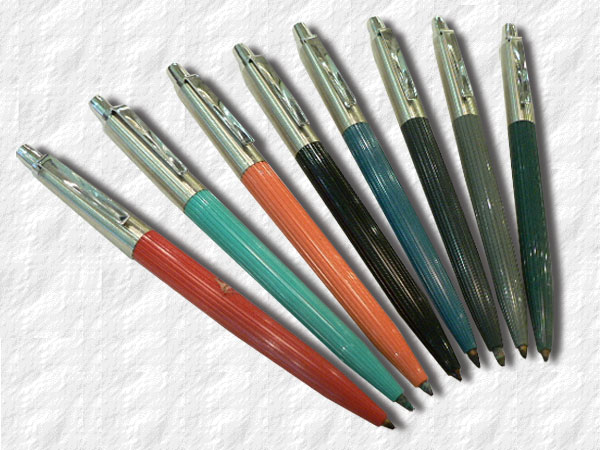
A fantastic collection of First Year Jotters, 1954.
Note the lack of the metal nib protector.
Parker continued to produce the Jotter for more than fifty years and it is still in production, still with features borrowed from the original Biró patent. The first 1954 Jotters were made from striped/ridged nylon, rather than plastic and came in the colours of black, grey, red, orange and green. There was also a Flighter model (referred to as the "custom") in all steel. The first pens didn't sport the arrow clip, but rather a plain clip previously found on some Parker "21", the "V clip" or "trough clip". Also they did not have the metal barrel tip of later models. They all had stainless steel caps with brass threads and was fitted with a new button actuator that besides hiding and showing the nib also rotated the refill thus inking the ball evenly from the inside.
This had the additional advantage that the ball was worn evenly. Other pens simply stopped working when the ball became oblong, while the Jotters ball got smaller, but was still round. The new pen cost $2.95.There was also a cap-actuated Jotter "51"model offered late 1954 with either lustraloy (DeLuxe), gold filled (custom) or rolled gold (Signet) caps, of course aimed to pair up with the Parker "51", these had the standard "51" clip and came in the colors of black, burgundy, navy grey, teal blue, forest green, midnight blue and cocoa. A later Jotter "51" was made to match the Parker "51" Special, referred to as the Jotter "51" Standard. These initially had shiny lustraloy caps, while later models had matte caps. These had black cap jewels to match the "51" Specials. (more: mk II 75 clip gold, lustra, black, rage red,dark blue, turqoise, grey. mk III metal jewels: black, rage red,dark blue, turqoise, grey, rarer burgundy, brown, green, )
By 1955 the Jotters were all made in plastic without the ridges. Late 1955 Parker began to add the metal tip to the barrels to prevent cracking. They were offered in the same colours as the previous year. In the UK Jotter "51"s were produced in solid in either 9 or 18 carat rolled gold (Gold Insignia) and rolled silver (Silver Insignia).
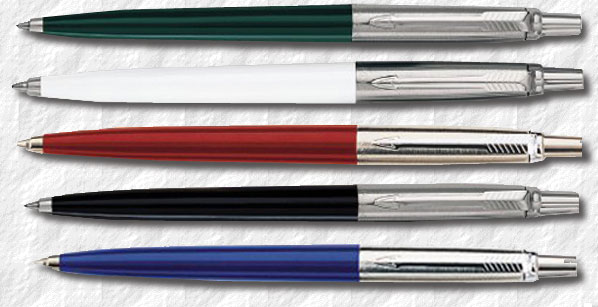
A collection of modern Jotters.
In 1956 the clip, still in the same manner as the clip of the Parker "21", was inverted, referred to as the "Inverted V clip" or the "Ridge clip" it still did not have the Parker arrow.In june 1957 Parker introduced the T-ball, a hard, durable tungsten carbide ball that was textured as to prevent skipping by better grip to the paper, a feature subsequently used on all ball pens today. The price was also lowered to $1.95
In 1958, at last, the Jotter got full Parker status and an arrow clip was fitted to the pen, it was of the same design as the clips found on the Parker "45". This design was virtually unchanged until 1972.
In 1962 a cap actuated Jotter "61" model was introduced.
In 1965 Parker offered a desk pen in black an brushed chrome.
By 1973 the button of the Jotter was redesigned. While the previous years had seen a lightly rounded button, it now became flat, sporting the Parker logo.
In 1980 the brass cap threads were replaced with cheaper plastic ones
xxxADDENDUM:(demi 4.5 inch, demonstrator, Arrow Jotter "45", Pardner, International Flighter, lunch room specials, Tiara 67-69 in black turqoise. orange (green?), Royal Wedding Jotter, 2004 50 yrs Jubilee Premier Edition licorice black, saffron yellow) Intro jotter pencil, roller balls, fountain pens.
2008: Stainless steel GT, CT, Special blue, black, red. Also roller ball, fountain pen and pencil
•••
Special thanks to Henry Gostony, David Shepherd and Stuart Schneider.