
| parkerpens.net |
| PARKERCOLLECTOR.COM |

 HOME PENOGRAPHY PENOGRAPHY PARKER DQ/BLACK LINE/PARKER X/RAVEN


 efore the Duofold era Parker was just one small pen manufacturer among dozens of others in the USA. The company offered more than 400 models of pens and produced even more. Every pen was hand made and if a customer wanted a custom made pen, well, that was all right with Parker. When the Duofold saw its way into the production line in 1921 it was for the first time appearant that the production line had to be slimmed down to meet the demands of the public for the Big Red. Since it was instantly regarded as a status symbol, it couldn't differ much from the features that sold it: it had to be big, it had to have a large gold nib and it had to be in red. Already in 1922 the number of models offered had been was reduced and only about a hundred fountain pens and forty five pencils were offered. This was also financially sound, since the Duofold sold for $7, while most black pens only cost around $3.
 n 1923 it was decided, although many at Parker was hesitant, to produce the Duofold also in black. It was clear that this would affect the sales of the Jack Knife pens which it also did, and although the Duofold at this time was a growing family in many sizes and designs Parker was unwilling to lower the price. A cheap Duofold wouldn't continue to be the status symbol it had become. Still, it was clear that the interest in the old Jack Knife safety pens was declining. What to do?
 Parker Black and Gold pens. The lined barrels remained, collectors usually refer to all lined pens as the "DQ" ever though the later pens didn't have the additional imprint, "Black Line" is also used to describe the model. The new Black and Gold pens came in six sizes, three with cap bands and three without. the smallest had the #2 nib size.
 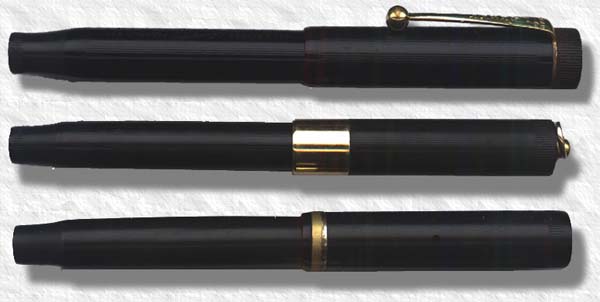 |
Top: A 1925 Parker X in plastic, sans cap band with clip. Middle: A 1926 Parker Gold and Black, Lady style in plastic with a broad cap band and a ring top. Bottom: A 1924 black hard rubber Parker "DQ", Junior with one cap band, no clip. |
 t this time Parker was threatened by Sheaffer who had begun to use the new material plastic in their production, allowing for more sturdy pens in other colours than red. To make things even more troublesome Sheaffer had also secured the rights to the new material with the largest manufacturers. Even so Parker managed to sign a contract with the plastic manufacturer DuPont and what better way to try out a new material than in a pen line that was cheap and also was not advertised. Thus the first of the Parker plastic pens, made from a material called pyroxylin (later referred to as "permanite"), was indeed the Black Line pens, marked with an X, Parker X. These of course are very collectible, especially the Senior, but can still be found at very reasonable prices in the collector community.
 he 1929 Parker catalogue depicts the Black and Gold pens with either two cap bands (following the 1928 Duofold redesign) or no cap bands. They cost $3.50 and $2.75, respectively. They had now lost the lenghtwise stripes, but still had the Lucky Curve banner. This changed in the 1930 catalogue, when the imprint read
|
discontinued and two other models were introduced to capture the low-end markets. The Parkette and the Challenger. Both models featured in other colours than black. |
© 1995-2019 Tony Fischier and The Parker Pen Company®/Sanford Ecriture.
This page is in no way sponsored by or created by the Parker Pen Company®. All opinions, views, and thoughts expressed herein are expressly the authors, and in no way reflect the opinions, views, or thoughts of the Parker Pen Company®/Sanford Ecriture. All logos and/or images on these pages are © Copyright of Parker Pen Company®Sanford Ecritureunless otherwise stated and is reprinted by kind permission. If You feel that Your copyright has been violated please contact the WEBMASTER.
Everything on this website is copyrighted by law and can not be used without written permission from the author, Tony Fischier. You may however use the information as reference material and although it is forbidden to make digital copies or reproductions it may be physically printed for personal use, which does not include use on other web pages or in advertising. You may however quote parts of the content of this website, digitally or physically, providing that the source and author is clearly stated, together with the copyright information. In the US referred to as Fair use. If you use any information on this site, add a link.
Feel free to donate a small sum through Paypal to help this site to stay online. Acknowledgements.
Parkercollector.com in translated versions