
| parkerpens.net |
| PARKERCOLLECTOR.COM |

 HOME PENOGRAPHY PENOGRAPHY PARKER VP
  1962—1964 |
||
 he Parker "VP" was the brainchild of Kenneth Parker who during the early 1950's had conteplated a pen with an adjustable grip to make life a little easier for left-handed writers and others that preferred a somewhat different writing angle. He discussed the matter with Parkers designer Don Doman, who designed many models for Parker. he Parker "VP" was the brainchild of Kenneth Parker who during the early 1950's had conteplated a pen with an adjustable grip to make life a little easier for left-handed writers and others that preferred a somewhat different writing angle. He discussed the matter with Parkers designer Don Doman, who designed many models for Parker.Don Doman was the design director for Parker from 1953 and although starting his own design firm in 1957 he was retained as a design consultant for Parker until he retired in 1986. Like Kenneth Parker he was an avid airplane pilot and most likely designed a few patterns for the painting of the official Parker airplanes of the 1950's and 1960's. Also Kenneth Parker's son Dan Parker was probably involved in the Parker "VP". Don Doman and Dan Parker was friends and their children grew up together. Kenneth Parker had stepped down as president in 1952, but remained as chairman. While George S. Parker, Kenneths grandfather and founder of the company, was more of a teacher and a business man, Kenneth and Dan was both very creative men with an eye for design. One of the first challenges for the newly hired Don Doman was to create this pen that would fit everyones hand. It would take some nine years to finish it, but it would eventually evolve into one of the most successful pen designs ever, the Parker "75". |
he idea was to create a nib that could be rotated to fit anyones writing angle, however peculiar they preferred to hold the pen. The cartridge or converter filled Parker "45" had been introduced in 1960 and had become a great seller, much because of the cartridge of course, but also because it was offered with a vast array of nib sizes. The nibs could be easily unscrewed and exchanged. The same priciple was suggested for the Parker "VP" and when it was introduced in 1962, it was offered with fifteen different nib styles, ranging from Needle point to an Extra Broad Executive. The choice of nibs and the rotating nib gave the user an option to arrange it as a Very Personal writer, hence the "VP". Also the gripping section was designed for a nice writing experience, it was triangular to fit nicely between the the two fingers and the thumb, used by most when writing. It also had grades imprinted in the plastic close to the nib, to help the user to quickly set the nib at the right angle. The second problem Parker was always trying to overcome was the problem of cleanliness. Filling a fountain pen almost invariably resulted in ink stained fingers. The capillary filled Parker "61" had been launched in 1956 and was designed to be inserted by the back into an ink bottle while the capillary force would literally suck the ink into the pen, without flipping levers, pressing buttons or screwing rods and most important - without getting hands dirty. |
|
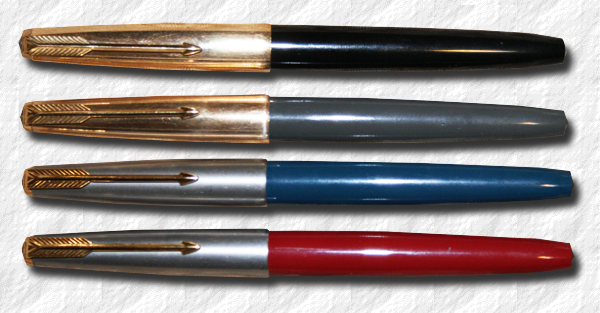 Photography ©2009 by and courtesy of Amir Eshel. |
The four colours and the two cap finishes of the Parker "VP", ca 1963. |
|
It was priced at $10, which made it a medium priced pen below the Parker 51, the standard model cost $ and the Parker "61" which cost $, but over the Parker "45", priced at $5. The different nibs had a number imprinted on them under the Parker name, denoting the style. Most of these nib numbers, but not all, translated into the later Parker "75" styles. |
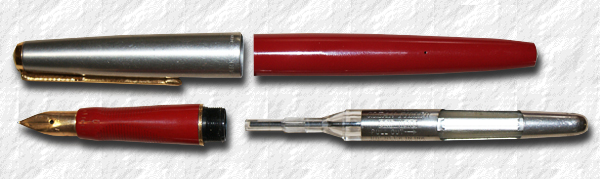
 nfortunately the filling system had proven complicated from a manufacturing point of view and the manufacturing cost was high. While the filling system had no moving parts it still required the user to sometimes wipe down the teflon tube filler, and furthermore, since most users didn't want to bother with keeping their writing instrument clean, they seldom had it washed or flushed clean of ink. Hence it eventually clogged.
 n 1962 it was produced in the four solid colours of
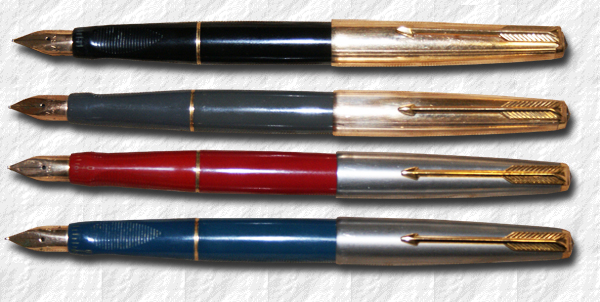 Photography ©2009 by and courtesy of Amir Eshel. |
Note the ribbed and graded gripping section. |
There were two cap finishes offered, Gold Filled and Lustraloy. This setup remain until the Parker "VP" was discontinued in 1964. By then it was clear that the design features, although some borrowed from the Parker "VP", of the newly launched Parker "75" was simply better. |
The Parker "VP" is easily recognisable through the large engraving VP in capital letters, on the cap, below the clip, and also it didn't have a tassie ring.
|
 encils were also offered, but no ball pens. A so called Holy Water Sprinkler, used by priests, was also offered. Instead of a nib this "pen" had a gold filled cup used for the holy water.
Photography ©2009 by and courtesy of Amir Eshel. |
Note the very unique filling system. |
© 1995-2019 Tony Fischier and The Parker Pen Company®/Sanford Ecriture.
This page is in no way sponsored by or created by the Parker Pen Company®. All opinions, views, and thoughts expressed herein are expressly the authors, and in no way reflect the opinions, views, or thoughts of the Parker Pen Company®/Sanford Ecriture. All logos and/or images on these pages are © Copyright of Parker Pen Company®Sanford Ecritureunless otherwise stated and is reprinted by kind permission. If You feel that Your copyright has been violated please contact the WEBMASTER.
Everything on this website is copyrighted by law and can not be used without written permission from the author, Tony Fischier. You may however use the information as reference material and although it is forbidden to make digital copies or reproductions it may be physically printed for personal use, which does not include use on other web pages or in advertising. You may however quote parts of the content of this website, digitally or physically, providing that the source and author is clearly stated, together with the copyright information. In the US referred to as Fair use. If you use any information on this site, add a link.
Feel free to donate a small sum through Paypal to help this site to stay online. Acknowledgements.
Parkercollector.com in translated versions